Evolution

How the brick got its shape, and its material.

Two threads run through five years of SeaBrick. One is the shape: more than twenty versions between January 2022 and the final design of 2026, each rendered here from its original design file. The other is the material: kelp, then flax and hemp, then mineral foam and fibre.

Part 1

Geometry and design, 2022 to 2026

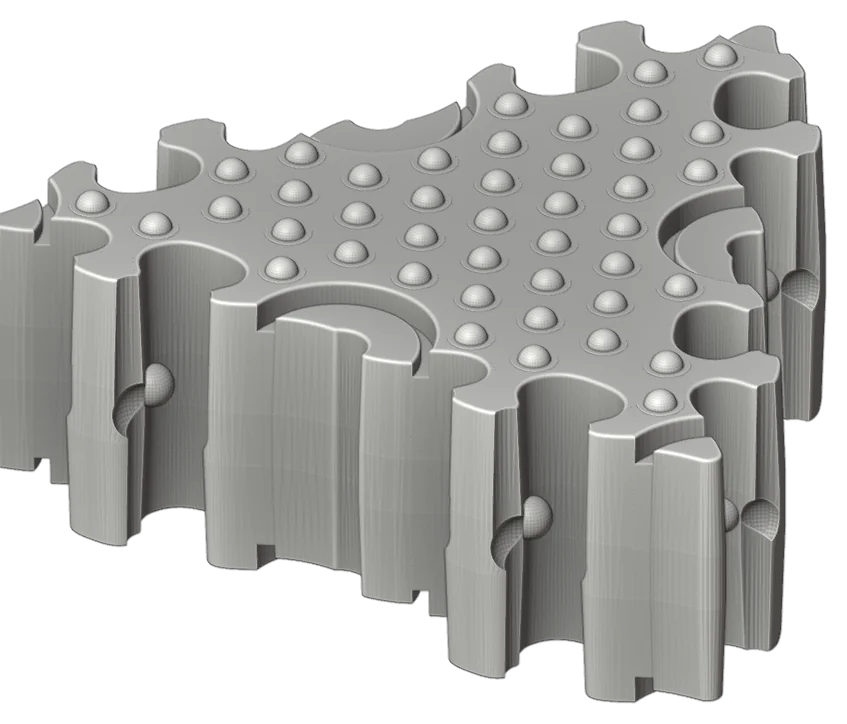
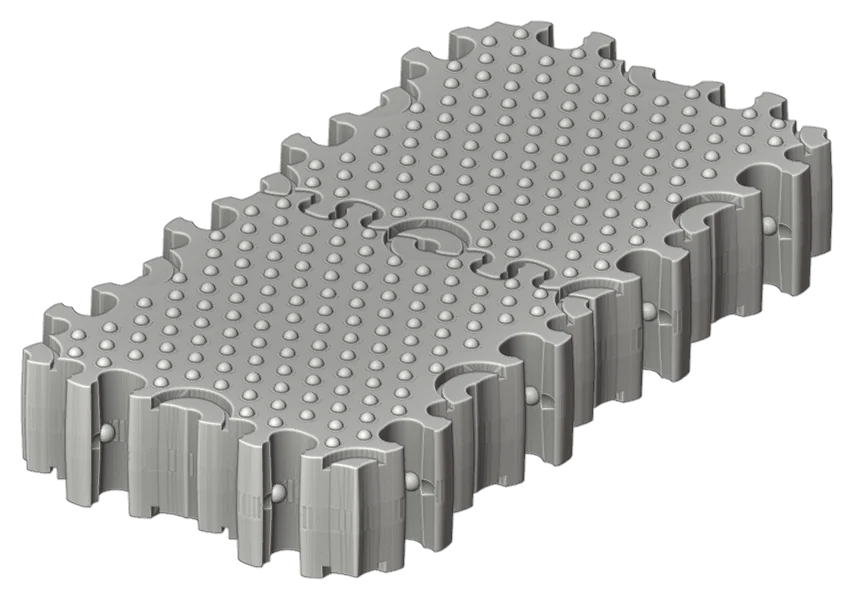
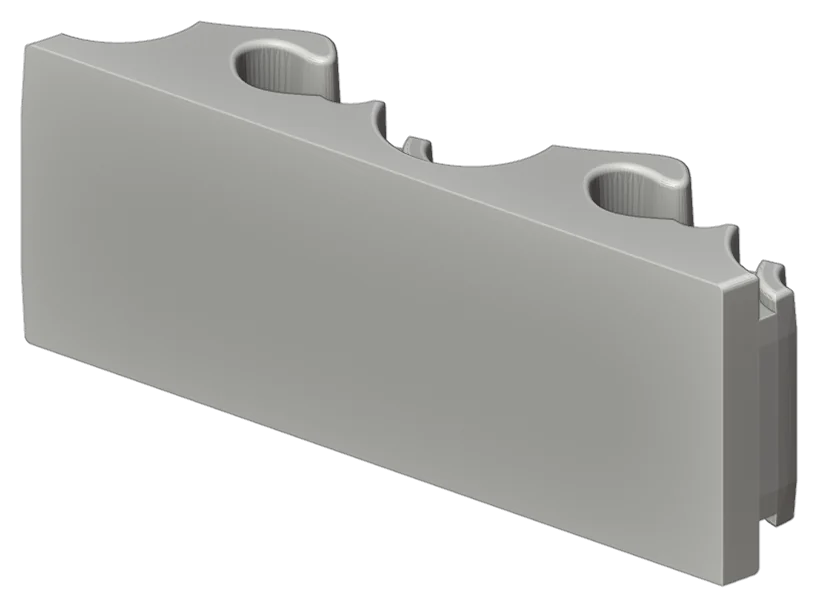
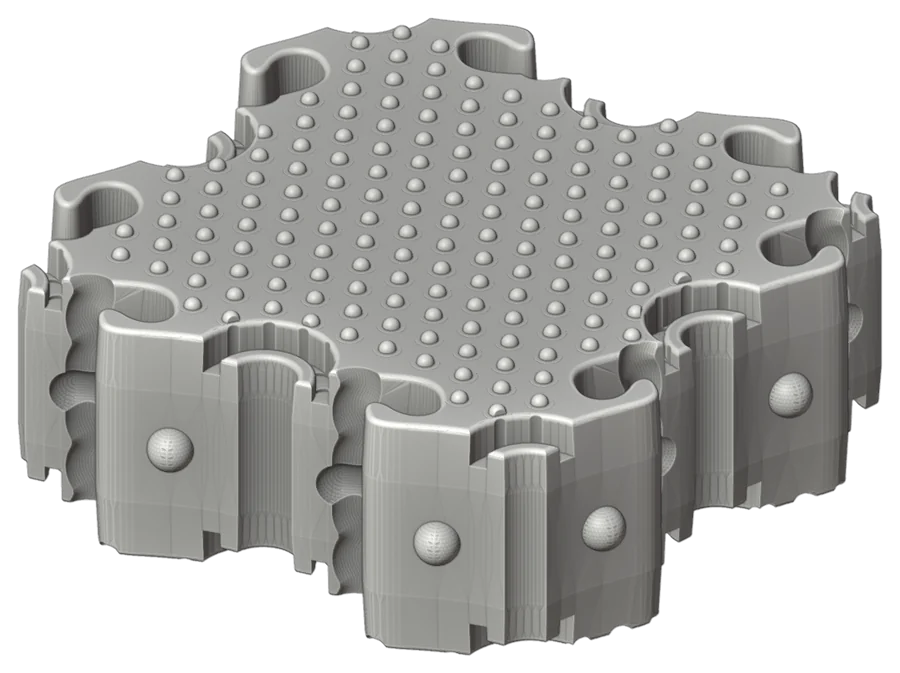
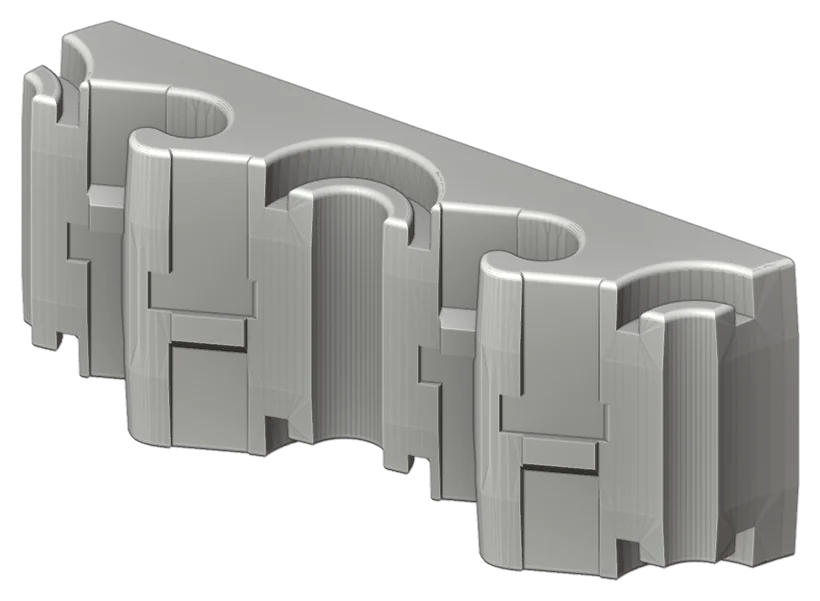
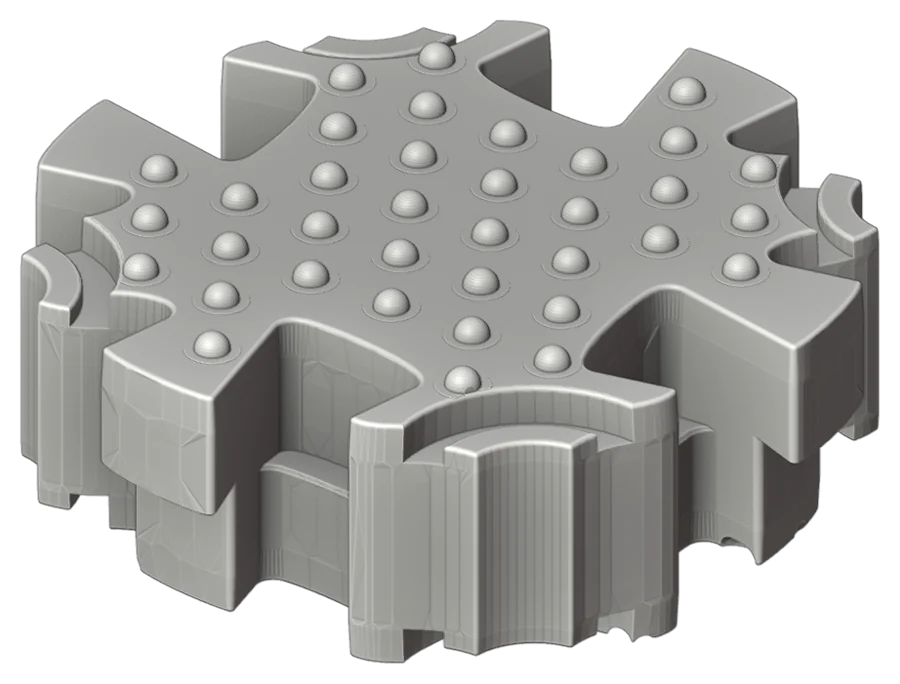
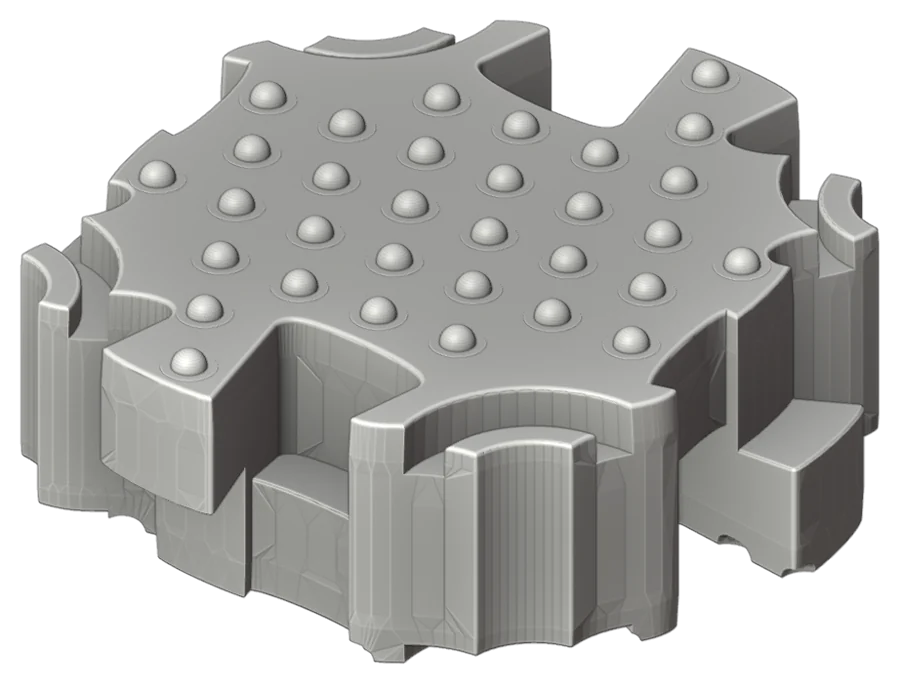
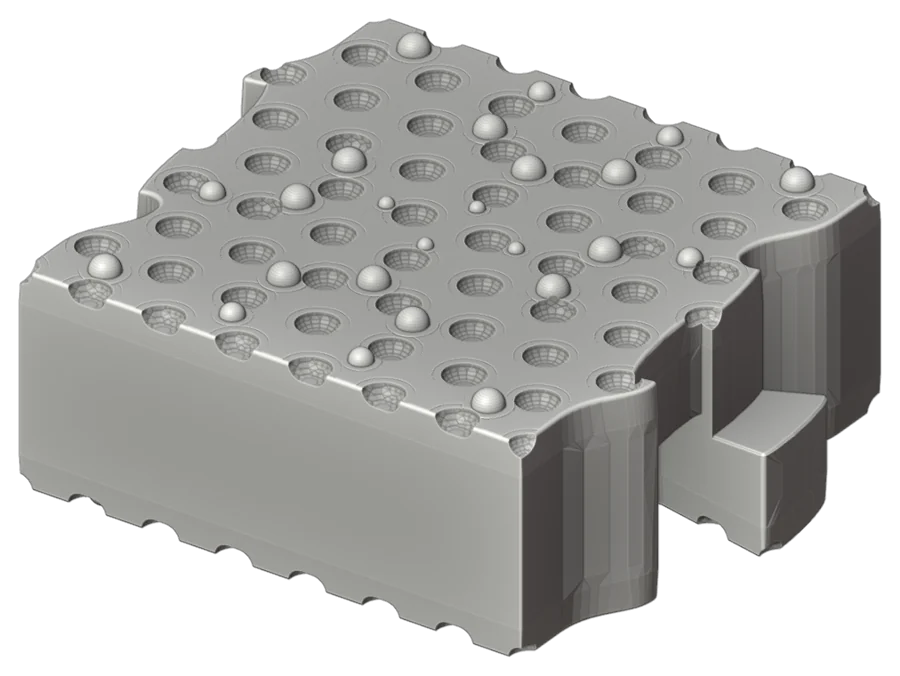
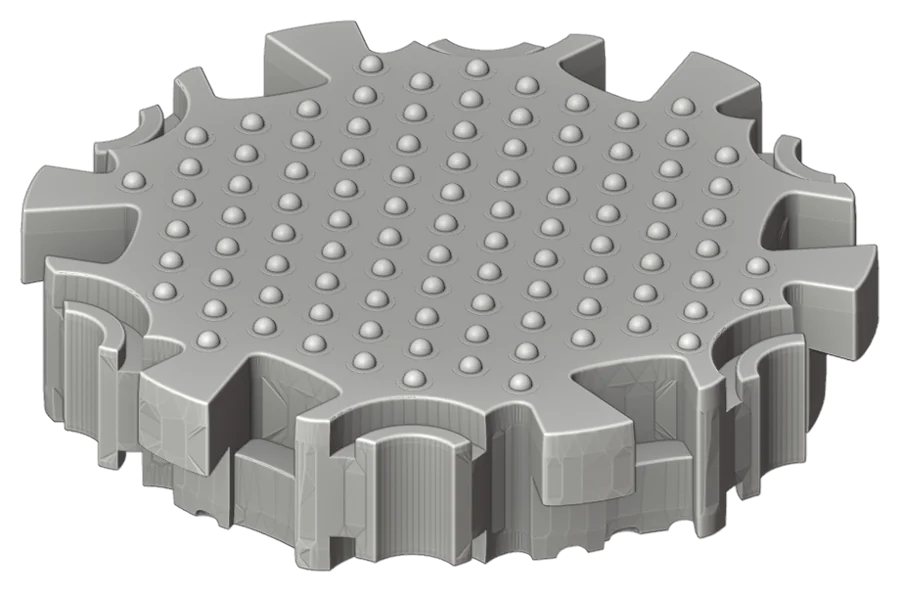
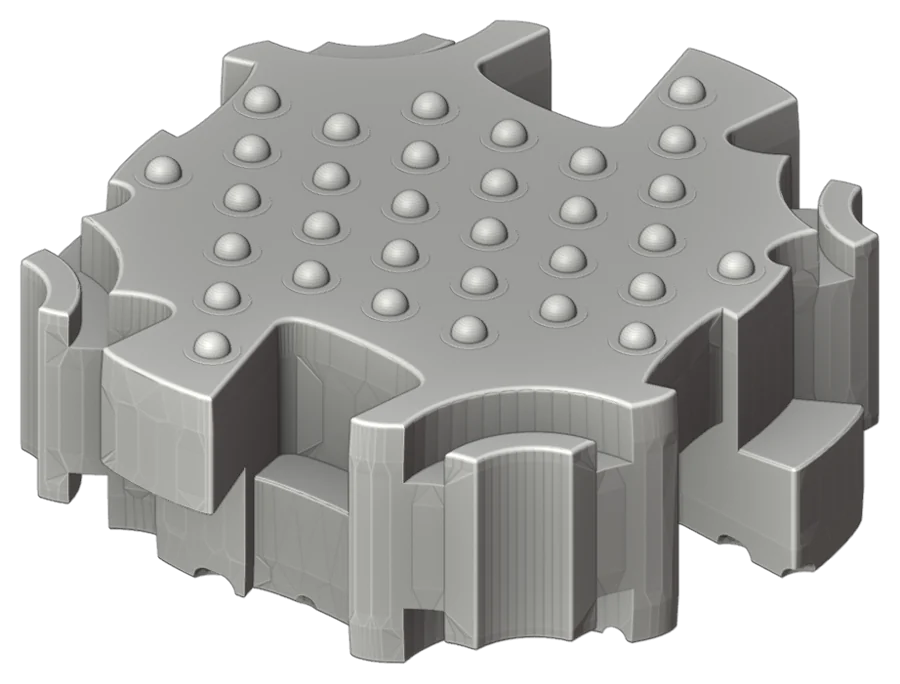
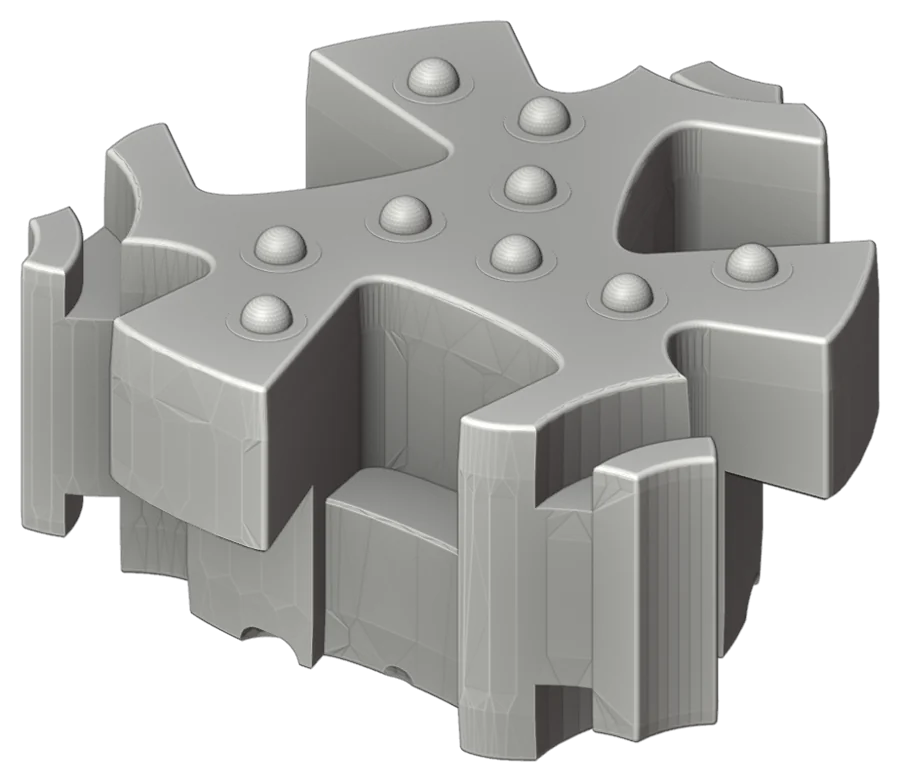
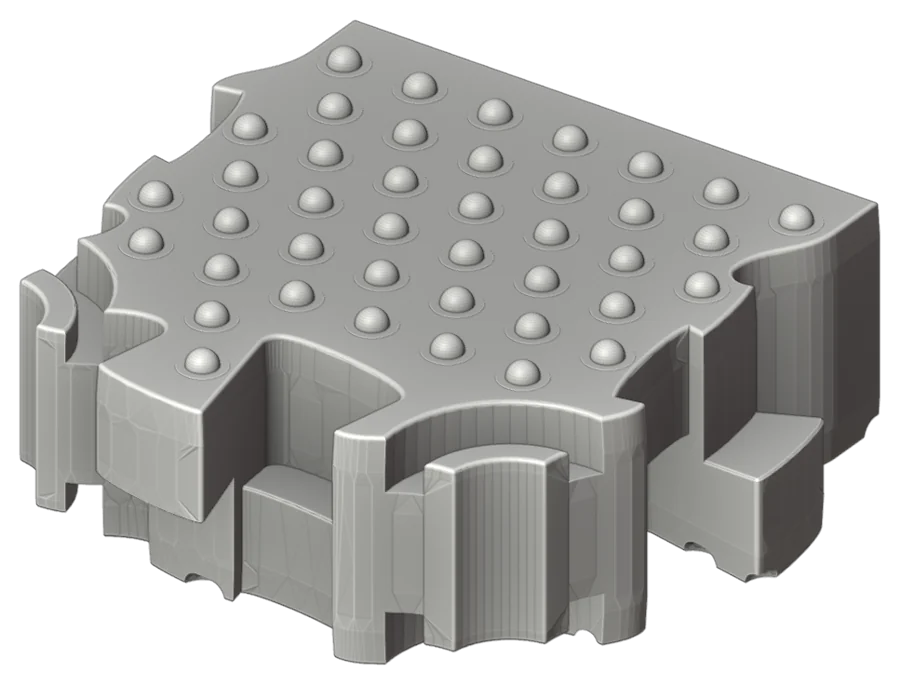
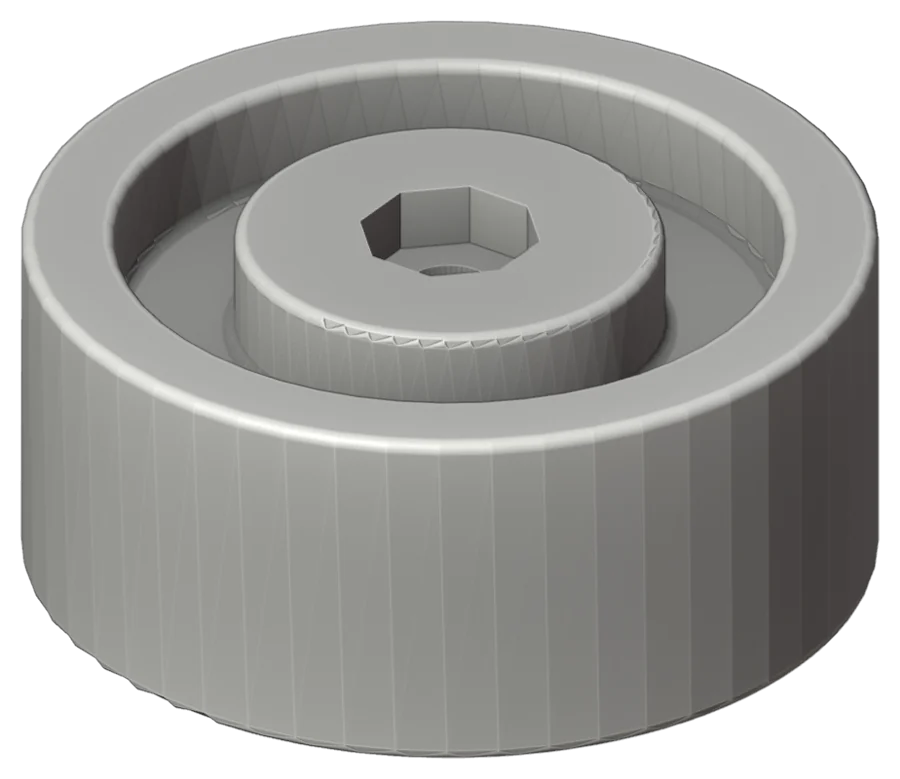
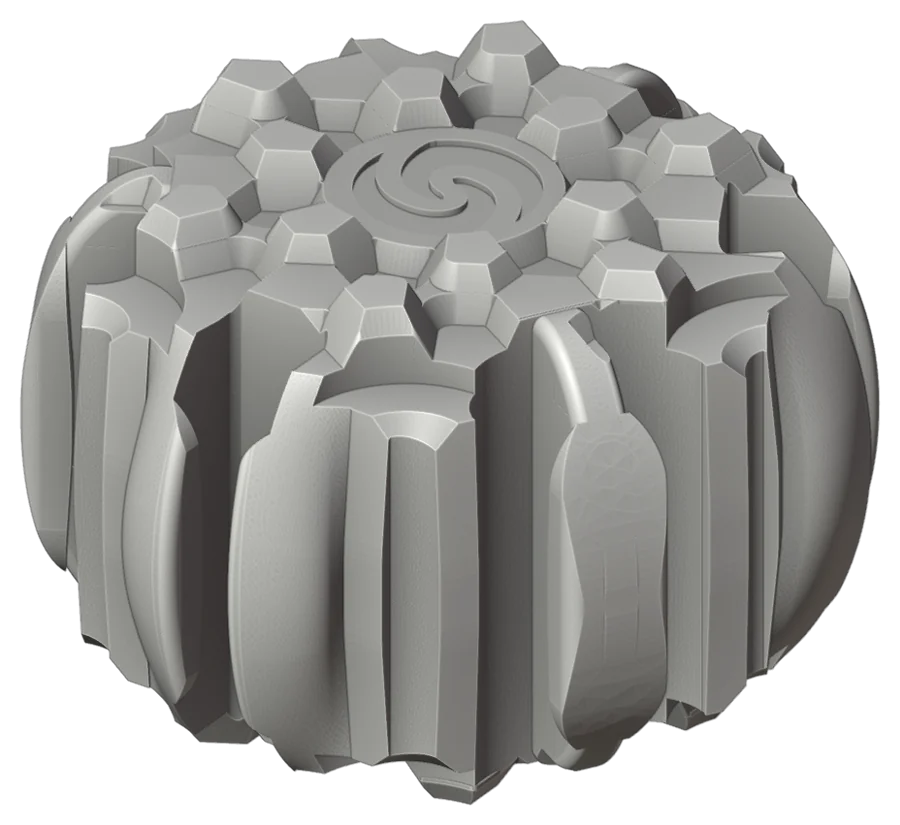
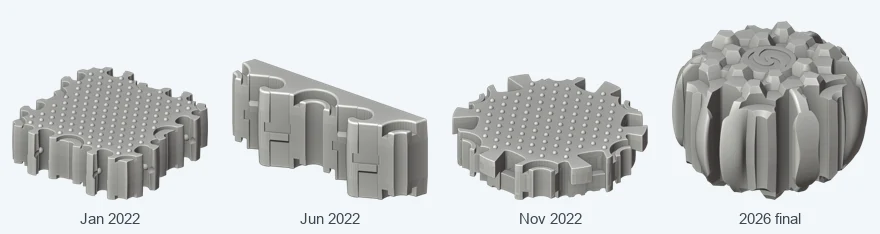
Four brick designs in a row, from the first square of January 2022 to the final SeaBrick of 2026
Four of the generations, each rendered from its design file.

Five turning points

  1. January 2022: a square brick. The first 3D model, printed within days at ten centimetres. More
  2. November 2022: the hexagon. Six equal neighbours and no long straight joints. Every design since has been a hexagon. More
  3. October 2023: the hinge-lock. Bricks that join with a turn instead of force. Declared final for the patent in September 2024. More
  4. January 2025: two moulded halves. The brick becomes parts that assemble, which solves the mould. A toy version at one centimetre follows and becomes a kit of fifty shapes. More
  5. August to October 2026: the final SeaBrick. A production design for a press, and a family of shapes drawn from it. More
Walkthroughs

Watch the brick explained

Videos John has made over the years to show how the bricks lock. The most recent shows the final locking system.

The production brick September 2026
The first 3D print of the full-size brick designed for compression moulding, and its locking system. The most recent walkthrough.
Putting bricks together, and taking them apart May 2026
A short video of the model bricks: how they click together, lock with a turn, and come apart.
The final locking system December 2025
The component brick at toy scale, in several shapes, with the locking system that every brick since has used.
SeaBrick demo October 2025
An eight-minute walk through the design on the first 3D prints of the final brick.
A floating SeaBrick April 2025
An eight-inch seaweed-fibre brick, moulded in two halves and sealed, floating in water.
Photographs

The bricks you could hold

Prints, moulds and cast prototypes, from the first ten-centimetre print to the toy family.

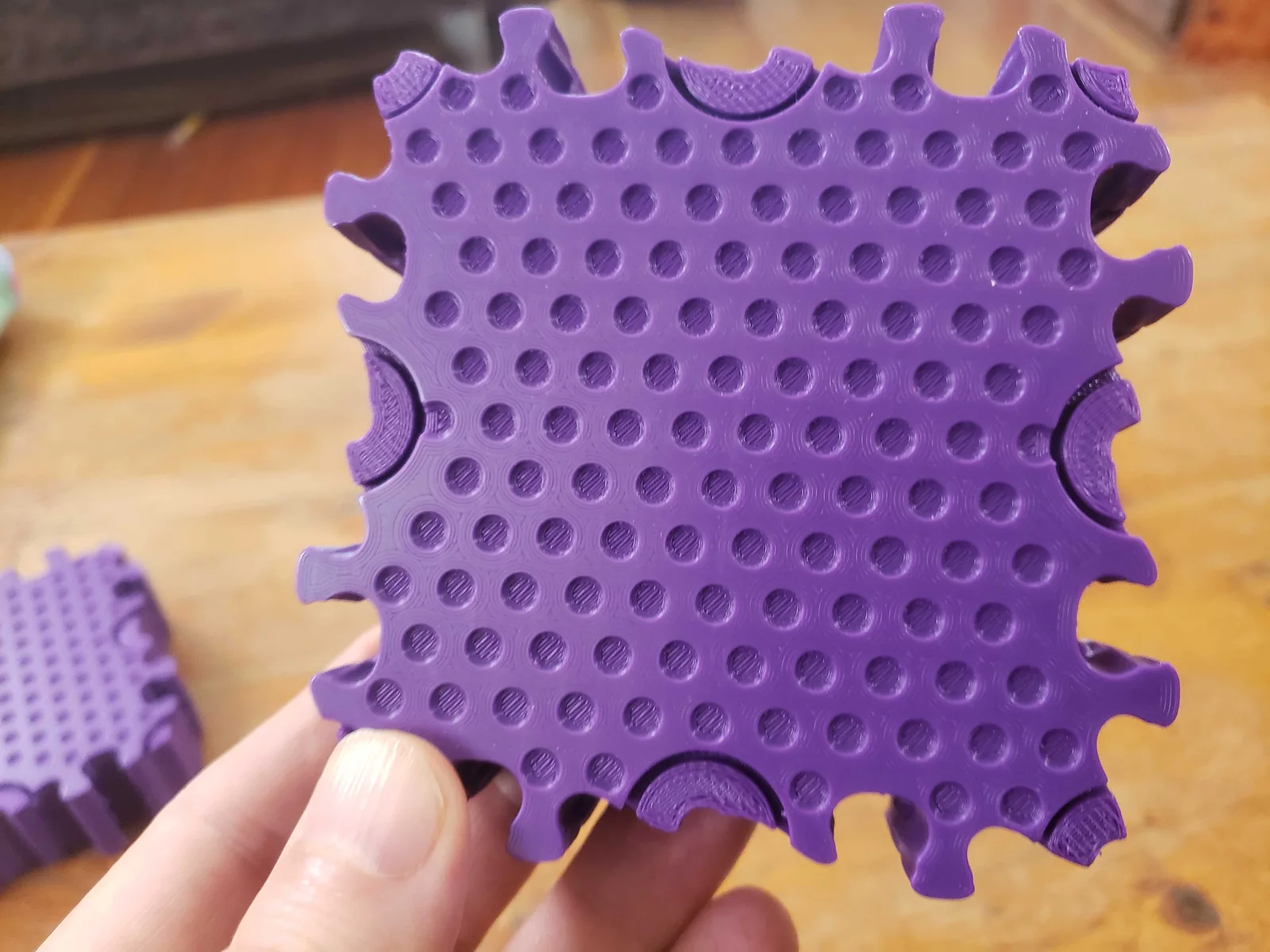
A hand holding a purple 3D-printed square brick with a grid of studs and edge tabs
February 2022 The first prints: the square brick, version 1, at ten centimetres.
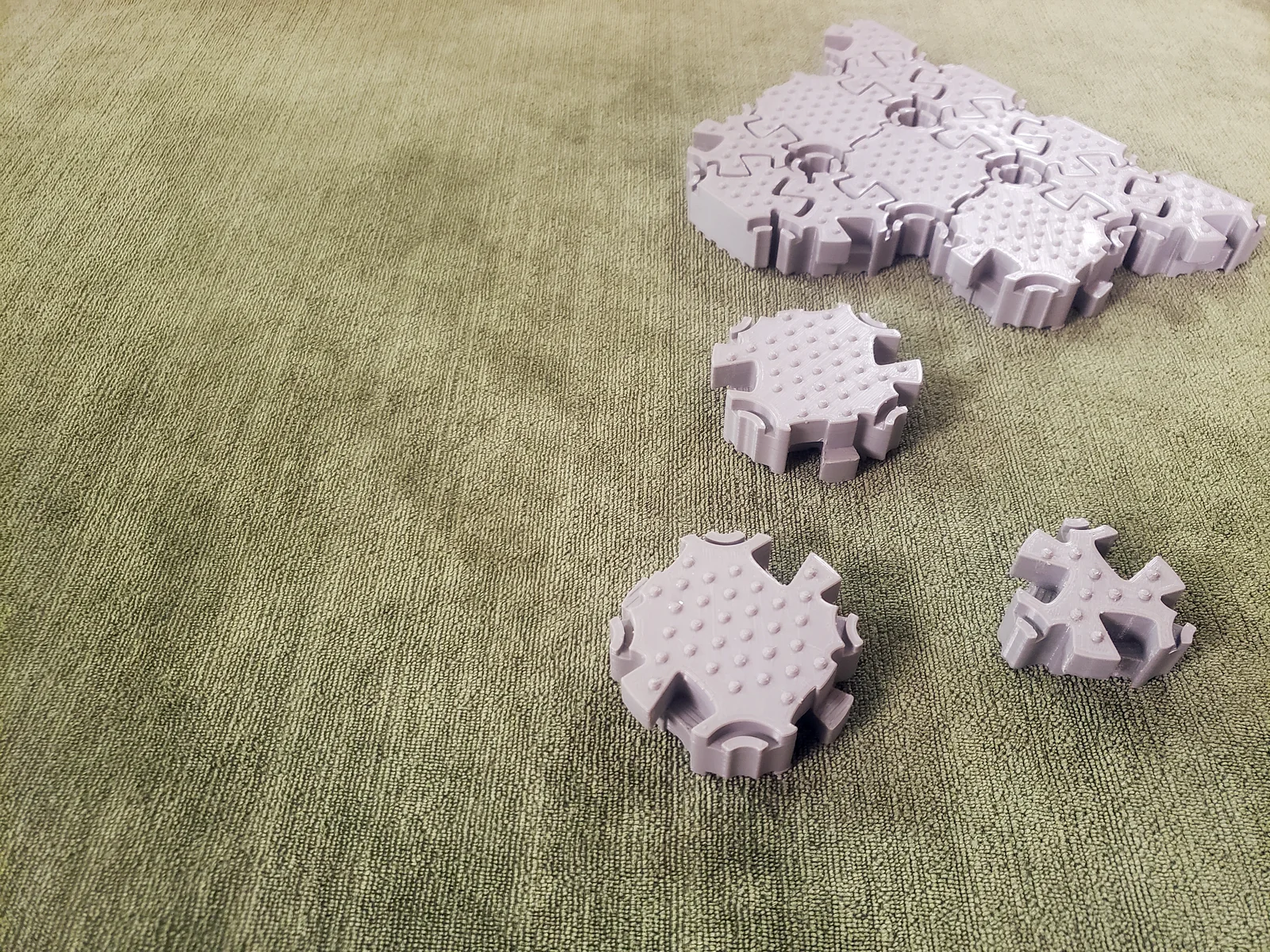
Grey 3D-printed square and quarter bricks locked together on a carpet
October 2022 Square and quarter bricks of the version 12 and 13 series, locked together.
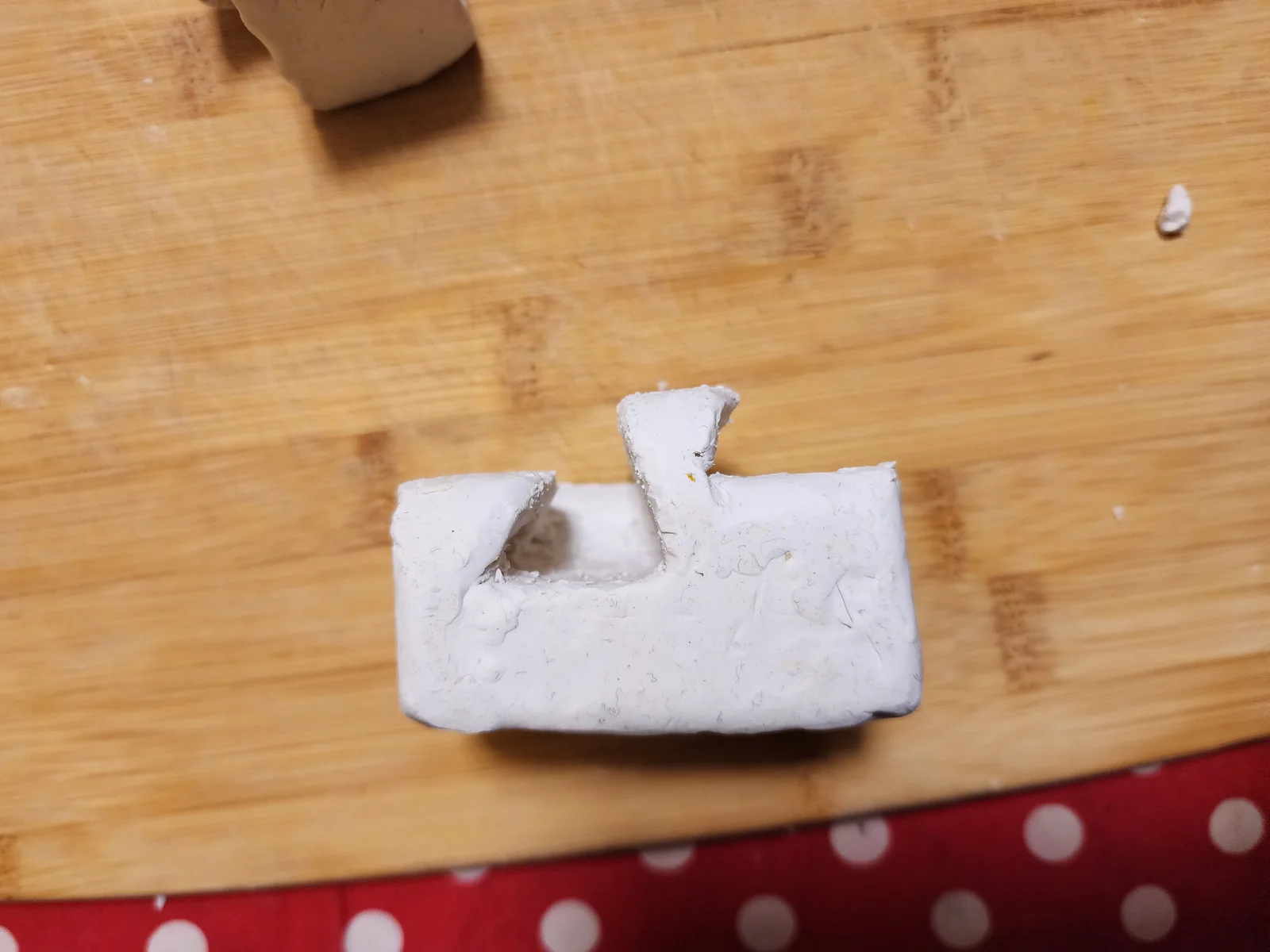
A hand-formed white cast test block with a slot cut into one side
April 2023 A cast test piece from the spring the lock was tried by hand.
Every generation

The full chronology

Era by era, with the design files rendered.

January to February 2022

A square brick, and a first print

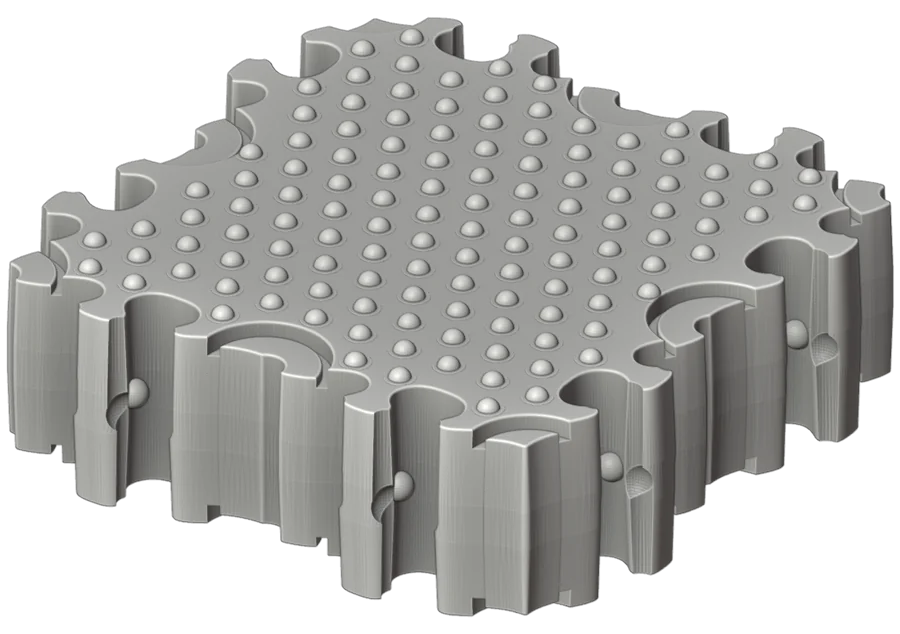
Eight months of sketches became a 3D model in the last week of January 2022, drawn by industrial designer Rico Jay Beringuela: a square brick with locking features on its faces, and a triangular partner so that a mat could turn corners. Within days 3DSMITH in Vancouver had printed the first ten-centimetre test pieces. The printer asked for STEP rather than STL files because the early meshes were coarse, which set the pattern for every version that followed.

Design: Rico Jay Beringuela. Printing: 3DSMITH, Vancouver.
Square brick, version 1, 29 January 2022
Triangular brick, version 1
Two square bricks assembled
The 18 February revision sent for printing
March to September 2022

Versions 3 to 19: a family of shapes

The first patent application, filed on 10 March 2022, already drew a family: square, triangle, hexagon, rhombus, trapezoid. Through the summer the versions ran past v19 as the locking features, wall thicknesses and the proportion of the brick were refined and printed, two or four at a time, at a fifth of full size. Edge bricks with one or two flat faces appeared in September so that a mat could have a clean perimeter.

Design: Rico Jay Beringuela. Printing: 3DSMITH.

Square brick v3, March 2022
Version 7, June 2022: the first printed in pairs
Version 13, August 2022
Version 15, September 2022
Two-edge square, v19, September 2022
November 2022

The hexagon arrives

Version 22, sent to the printer on 2 November 2022, was the first set to include a hexagonal brick alongside the squares and triangles. Version 24 three weeks later added two plug designs to join one course to the next. The STL and STEP files for the square and triangle went to UBC the same month, where the Capstone students were preparing to mould the first composite bricks.

Design: Rico Jay Beringuela. Printing: 3DSMITH. Moulding trials: UBC Materials Engineering Capstone team.

Hexagon brick, v22 to v24, November 2022
Square brick, v24
Square brick, v24
Triangle brick, v24
Triangle brick, v24
One-edge square, v24
Double plug joining two courses
2023

Hollow bricks, by hand

When the UBC results showed the kelp composite was about as dense as water, the brick had to become hollow to float well. Through 2023 the work moved to moulds rather than bricks, and to plaster prototypes cast by hand to try the locking system of that generation, a set of bumps and tongues. The 3D scans made of those prototypes in September 2023 survive, but no brick CAD was drawn that year: the design moved on through the mould.

Moulds: Rico Jay Beringuela. Composite: UBC BioProducts Institute. Prototypes: SeaBrick.

No brick design files from this year; the work was in moulds and hand-cast prototypes.

October 2023 to October 2024

The hinge-lock

The bump-and-tongue system was superseded in October 2023 by the hinge-lock, in which bricks join and separate with a rotating motion instead of brute force. Brady Kirk scanned and printed the physical prototypes; Xiaoyuan Geng modelled the first versions in animation software; in August and September 2024 Rico rebuilt the design in SolidWorks as a square and a triangle, each printed as top and bottom halves at an eighth and a sixteenth of full size, with three candidate plug designs. The hinge-lock was declared final for patent purposes in September 2024.

3D printing and scanning: Brady Kirk. Modelling: Xiaoyuan Geng, Rico Jay Beringuela. Printing: 3DSMITH.

Renders of this generation are not published while the design is under review. The text describes it.

January to June 2025

The two-half component brick

To solve the mould problem, Zachary Huser redesigned the brick as two moulded halves that assemble into one unit, delivered in January 2025 with a two-degree draft so the halves would release. Brady Kirk printed them at full size in February, and an eight-inch brick was float-tested. In May and June the hinge-lock itself was rebuilt in SolidWorks, the first time the project's own CAD was in-house.

Design: Zachary Huser. Printing: Brady Kirk. SolidWorks: SeaBrick.

Renders of this generation are not published while the design is under review. The text describes it.

August 2025 to January 2026

Puzzle bricks at one centimetre

With the component idea proven, the brick shrank to a one-centimetre toy so that whole structures could be built and held in the hand. The "puzzlebrick" series ran to eighteen versions in the autumn of 2025, then became a family: hexagon, trapezoid, rhombus and triangle, each in single, double and triple heights, with yokes to tie them together. A provisional patent on the component design was filed on 9 December 2025.

Design and printing: SeaBrick, with Brady Kirk.

Renders of this generation are not published while the design is under review. The text describes it.

February to June 2026

A thousand toy bricks in fifty types

From February 2026 the toy family grew into a kit: hexagons, rhombs, trapezoids, triangles, rectangles, huts and tents, in one, two and three heights; sloped and clad pieces for roofs and walls; corner and T-joints; stud-and-tube cladding so the kit could meet other toy systems. About a thousand bricks were printed, and on 13 June 2026 friends and advisors spent an afternoon building with them to choose the first brick set.

Design and printing: SeaBrick.

Renders of this generation are not published while the design is under review. The text describes it.

June to July 2026

A simpler lock face for a press

In parallel with the toys, the full-size brick was redrawn for a compression press: a hexagon with a simpler lock face that a two-part mould can release. The "simple lockface" series tried three-, four- and five-sided variants, then a press brick, in June and July 2026.

Design: SeaBrick, in SolidWorks.

The design files from this stage show the connector faces of the current brick, which are not published.

July to August 2026

The faceted surface

In the second half of July the lock face changed character: the flat top became a field of small facets around a central boss, so that courses register on each other at many points instead of a few. The "flower" and "cone" studies of late July became the brick of 4 August 2026, with a matching base.

Design: SeaBrick, in SolidWorks.

The design files from this stage show the connector faces of the current brick, which are not published.

September to October 2026

The final SeaBrick and its family

In September 2026 the design was completed for production, with a holder for the press, and in October the family was derived from it: half bricks ending in a claw or a tongue, edge bricks with four or five connectors, thin wall pieces, a two-flat-face wall brick, a double-height bridge and two upright wedge inserts for wall boundaries. These are the shapes in the builder, which shows smoothed versions that omit the connector surfaces; the connector faces themselves are not published.

Design: SeaBrick, in SolidWorks.

The final SeaBrick, smoothed visualization model

Renders are made from the project's archived design files, in the orientation of the original file. Early files were drawn to be printed at a fifth to a sixteenth of full size.

Part 2

Material technology, 2021 to 2026

2021 to 2023: kelp

SeaBrick began as an idea about kelp: a feedstock that grows two feet a day and stores carbon, harvested and pressed into a building block. Six UBC Materials Engineering students took it on as a Capstone project in 2022 and made a kelp fibre composite stronger than concrete in compression. A research agreement with UBC's BioProducts Institute followed. The composite was named Kelpstone, and small specimens reached three times the compressive strength of concrete at half the weight. Its density, close to water, is why the brick became hollow.

2024 to 2025: other fibres, and keeping water out

Work in Western Australia showed that sargassum worked as well as kelp, with a simpler process. When seaweed fibre could not be bought at the scale a pilot needed, flax and hemp from the Prairies were tested in 2025 and maxed out the compression press. In parallel, an Ocean Supercluster grant funded a study of a mineral waterproofing method that needs no petrochemicals and sheds no microparticles.

2026: mineral foam and fibre

The current material turns the composite inside out. A low-density mineral foam core gives buoyancy. A dense mineral shell carries the loads where bricks meet. Organic fibre runs through both and mineralizes over time into an internal scaffolding that gives strength and flexibility. The brick turns to stone, and gets stronger as it does. Where the material stands.

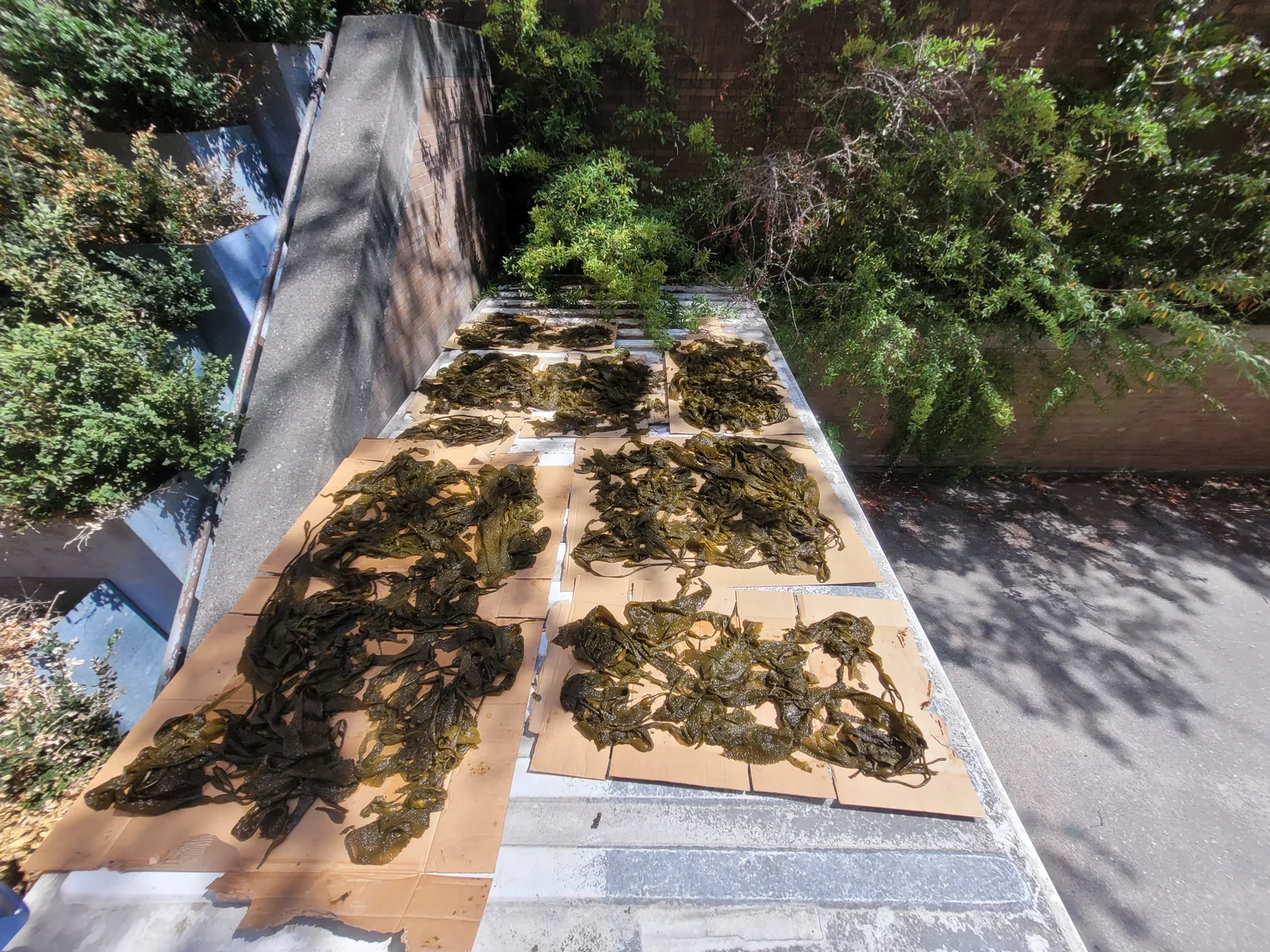
Kelp drying on racks
2022: kelp feedstock drying at UBC.
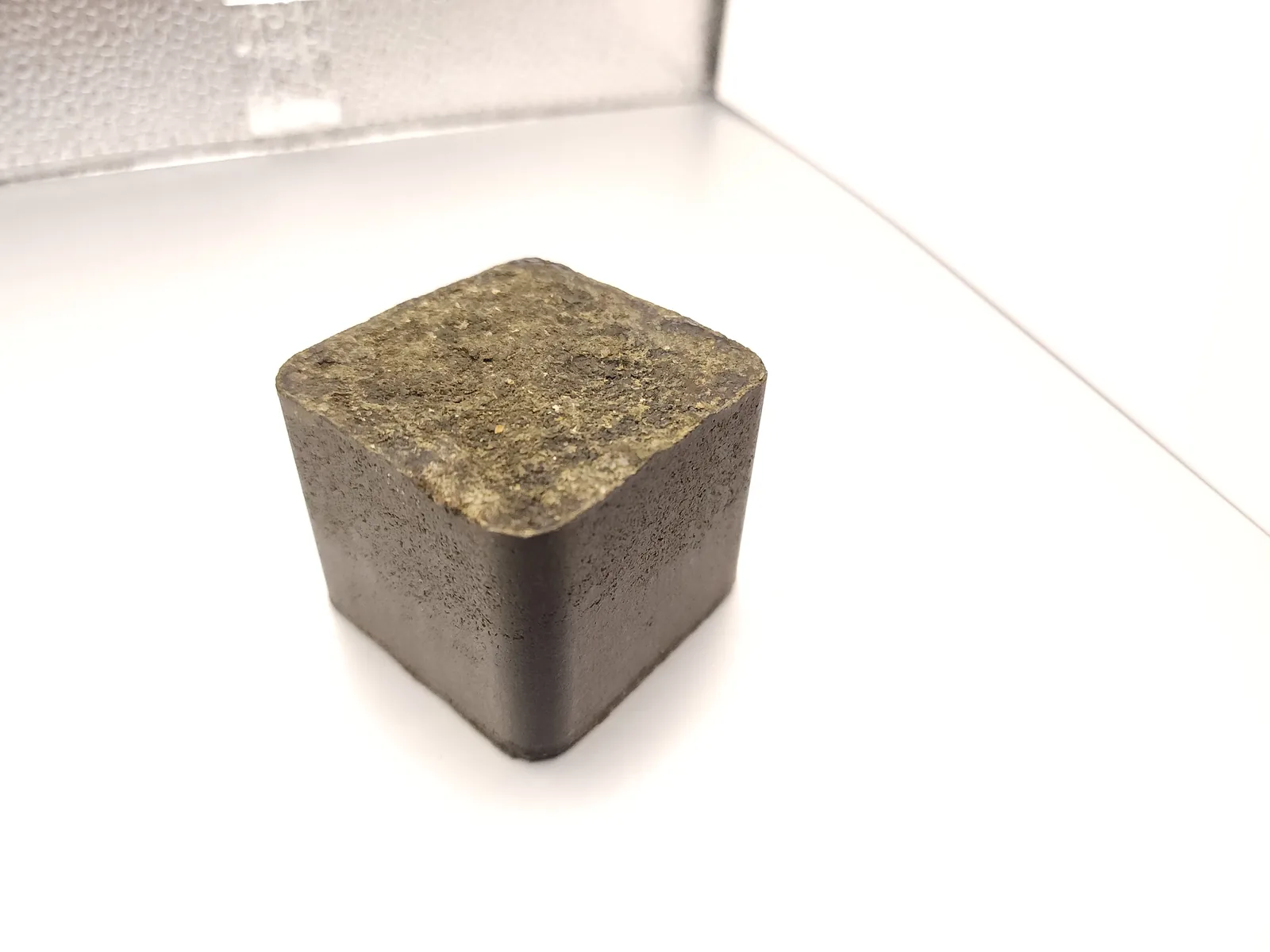
A pressed kelp composite cube
2023: a Kelpstone test cube.
A mould being filled with composite feedstock
2023: filling a mould.
2021–23 Kelp fibre composite research stage 2025 Flax and hemp fibre research stage 2026 → Mineral foam + fibre current direction MATERIAL STRATEGY OVER TIME
Three stages, one direction: a material that floats, lasts in seawater and stores carbon.
2021–23Kelp fibre composite ("Kelpstone"), with UBC
2024–25Sargassum; flax and hemp; mineral waterproofing study
2026 →Mineral foam core, mineral shell, mineralizing fibre