
Five years, one brick, several materials.
SeaBrick began in 2021 as an idea about kelp and coastlines. The brick has been through more than twenty versions and its material three stages since. This is the short version; the journal has the long one.
An idea called Kelp Island
A research document about building coastal infrastructure from kelp becomes a project. The first pitch, in September 2021, already describes coastal cities building out onto the water. In August the idea changes from a ceramic block to a compressed plant-fibre brick formed in a mould.
SeaBrick Society incorporated
A nonprofit is formed to hold the brick and the research. Its purpose: to promote innovation and standards around environmentally sustainable marine infrastructure building materials.
First designs and first prints
A 3D designer turns eight months of sketches into a brick; 3DSMITH in Vancouver prints the first ten-centimetre bricks within days. The first patent application is filed on 10 March 2022, with drawings of a whole family of shapes.
Kelp fibre composites at UBC
Six UBC Materials Engineering students take SeaBrick on as a Capstone project and make a kelp composite stronger than concrete. Its density, close to water, leads to a hollow brick.
Kelpstone
A sponsored research agreement with UBC's BioProducts Institute. The composite is named Kelpstone; small specimens test at three times the compressive strength of concrete at half the weight. Three more Capstone teams join in the autumn. A small manufacturing space is leased on Venables Street.
Recognition
Accepted to the Third Derivative climate accelerator. Climate Spotlight winner at the Ocean Impact Pitchfest in Sydney. Nominated by Ashoka for the 2024 Earthshot Prize.
The hinge-lock
The tongue-and-bump lock is replaced by a hinge-lock, developed with 3D printing advisor Brady Kirk and designer Xiaoyuan Geng, and declared final for patent purposes in September 2024.
Perth, sargassum and a waterproofing grant
Materials work continues in Western Australia with a simpler process; sargassum proves to work as well as kelp. Canada's Ocean Supercluster funds a study of a mineral waterproofing method. Three further patent applications are filed on kelp processing and farming.
Flax, hemp and a float test
With seaweed fibre unobtainable at scale, flax and hemp from the Prairies are tested and max out the press. An eight-inch hexagonal brick moulded in two halves is float-tested in February. UBC students run the waterproofing study.
The component brick
The brick is redesigned in SolidWorks as a set of simpler moulded parts that assemble into one unit, solving the mould problem. A provisional patent on the new design is filed on 9 December 2025.
A thousand model bricks
About a thousand toy-scale bricks in some fifty types are printed. On 13 June 2026 friends and advisors spend an afternoon building with them to choose the first brick set.
Mineral foam and fibre
The material moves to a mineral foam core with a dense mineral shell and mineralizing fibre. In September the first production brick design, made for a compression press, is completed.
The materials thread
Three stages, one direction: a material that floats, lasts in seawater and stores carbon.
| 2021–23 | Kelp fibre composite ("Kelpstone"), with UBC |
|---|---|
| 2025 | Flax and hemp fibre composites |
| 2026 → | Mineral foam core, mineral shell, mineralizing fibre |
The shape thread
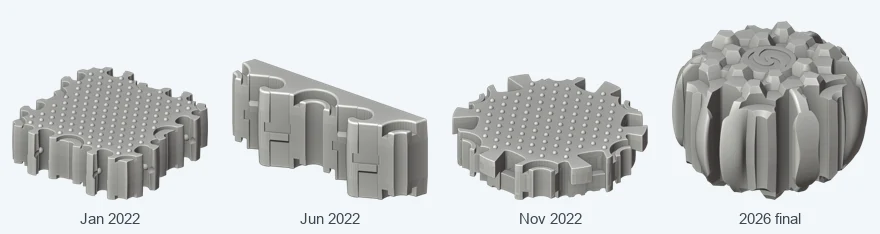
Square slab, a family of shapes, a hollow two-part brick, the hinge-lock, the component brick, a thousand toy bricks, and the final SeaBrick. The evolution page shows each generation; the journal tells the story.
People
Dozens of engineers, designers, researchers and climate activists have carried the work, with UBC faculty and more than twenty engineering students. They are named in the journal articles that describe what they did.