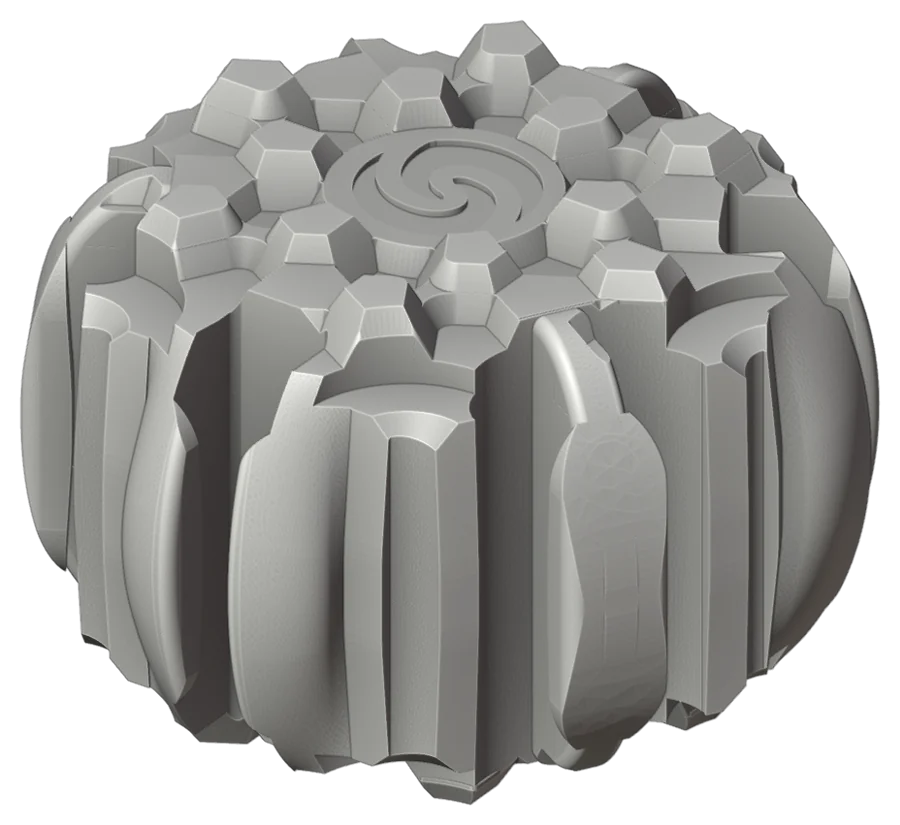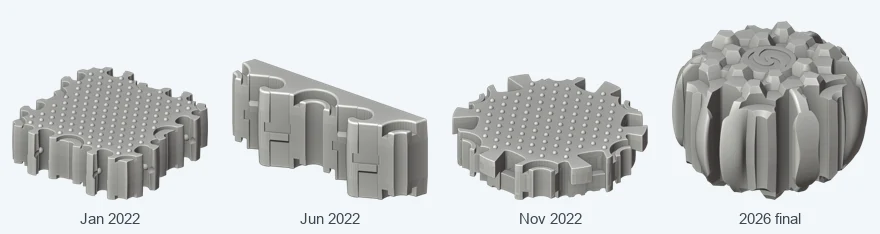
A SeaBrick has to do three things at once. It has to float. It has to lock to its neighbours well enough that a platform of thousands behaves like one body. And it has to come out of a mould cheaply, anywhere in the world. Most of the design history is those three requirements arguing with each other. The pictures are rendered from the original design files; the evolution page has the full set, the walkthrough videos and the photographs.
2022 began with a square and ended with a hexagon
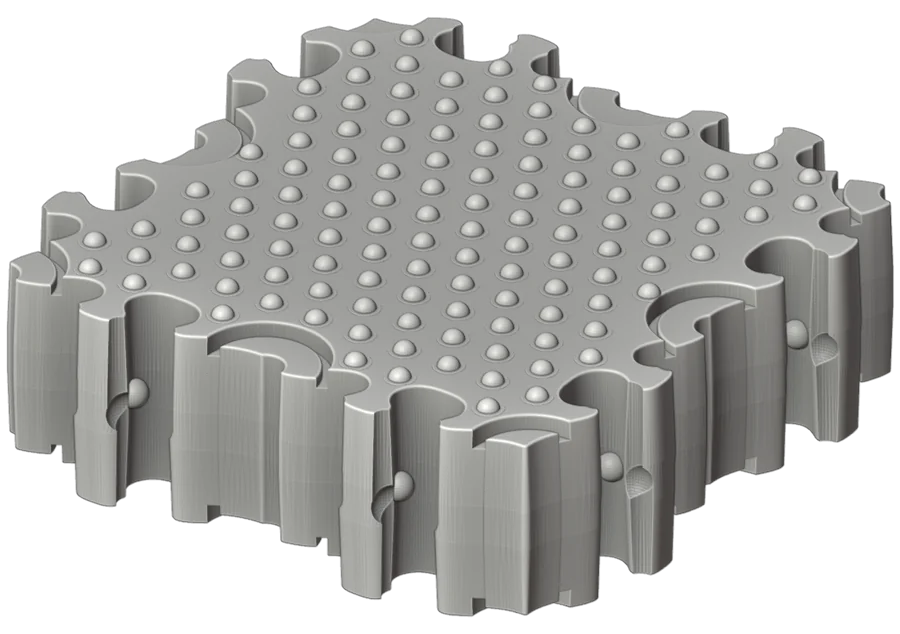
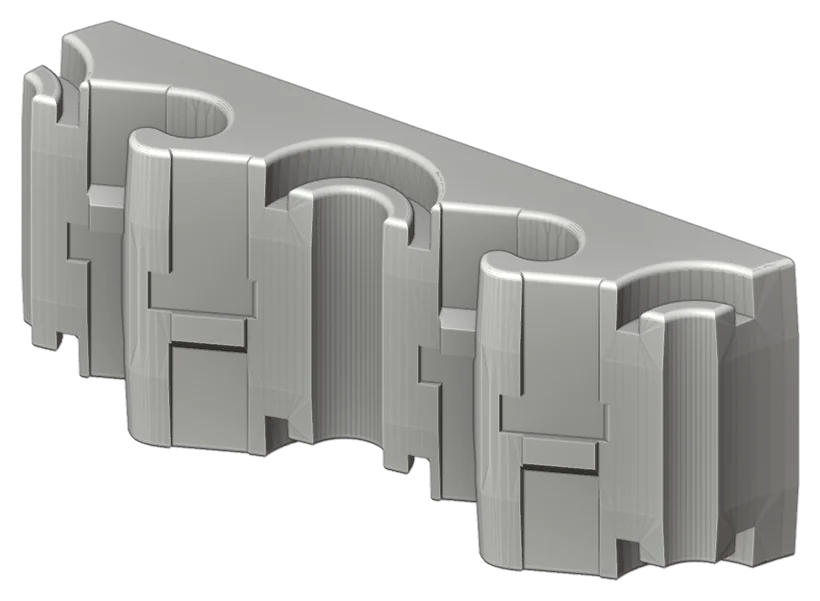
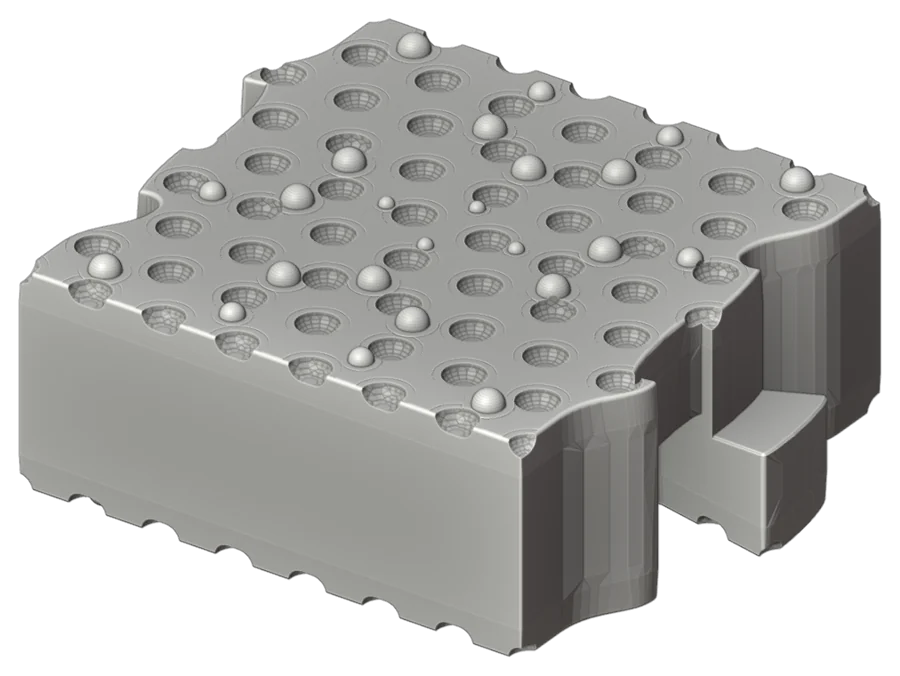
The first 3D designs were drawn by industrial designer Rico Jay Beringuela in January 2022 and printed within days at 3DSMITH, a small Vancouver studio, at ten centimetres across. The drawings for the first patent, in March 2022, already showed a family: square, triangle, hexagon, rhombus, trapezoid and a "mini". Unlike Lego, which is built on a square, SeaBrick uses a triangular pattern, so the family tiles together. Through the year the versions ran past twenty as the lock and the wall thickness were refined. The first hexagon went to the printer in November. Every design since has been a hexagon.
The material made the brick hollow
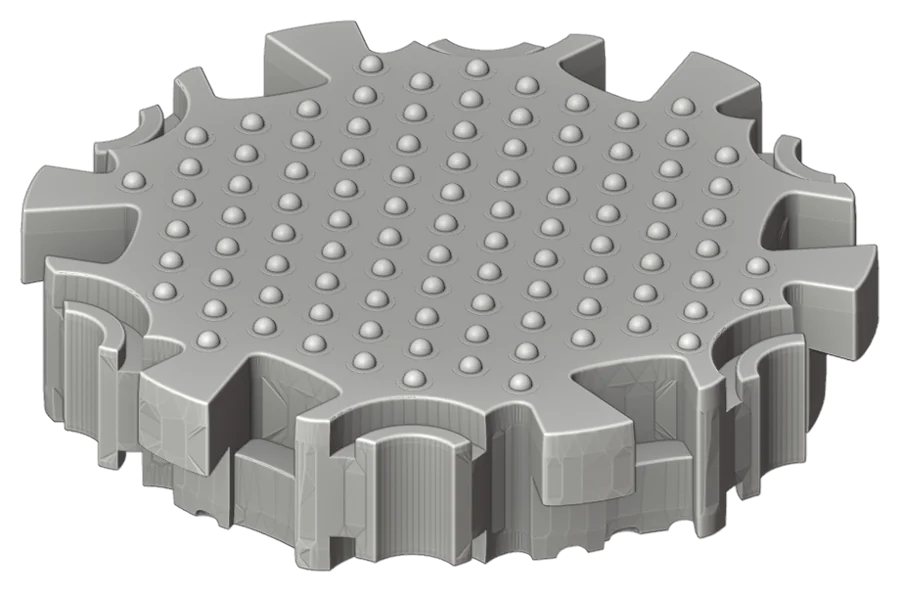
When the UBC results showed the composite itself was about as dense as water, the brick became a two-part shell with hollow cells inside. A February 2023 walkthrough video documented the lock of that generation, a set of bumps and tongues, and plaster prototypes were cast that spring to try it by hand. The brick is moulded in two halves, top and bottom, which is how the internal honeycomb is made.
The hinge-lock replaced force with a turn
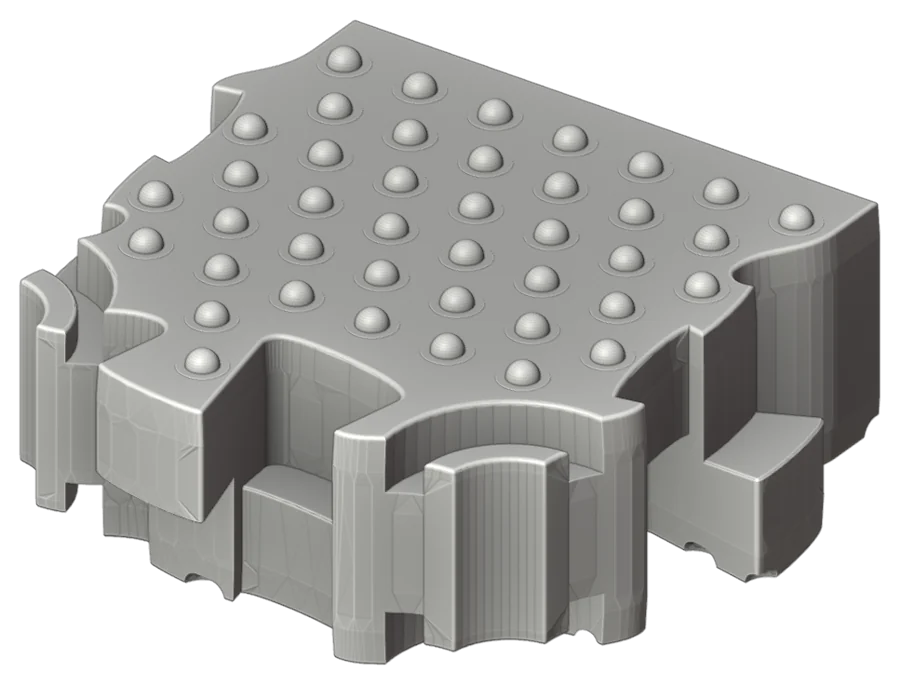
In October 2023 the bump-and-tongue lock gave way to the hinge-lock, developed over the following year with 3D printing advisor Brady Kirk and designer Xiaoyuan Geng. Bricks could now be joined and separated with a rotating motion instead of brute force. In September 2024 the hinge-lock was declared final and sent to patent counsel.


The component brick solved the mould
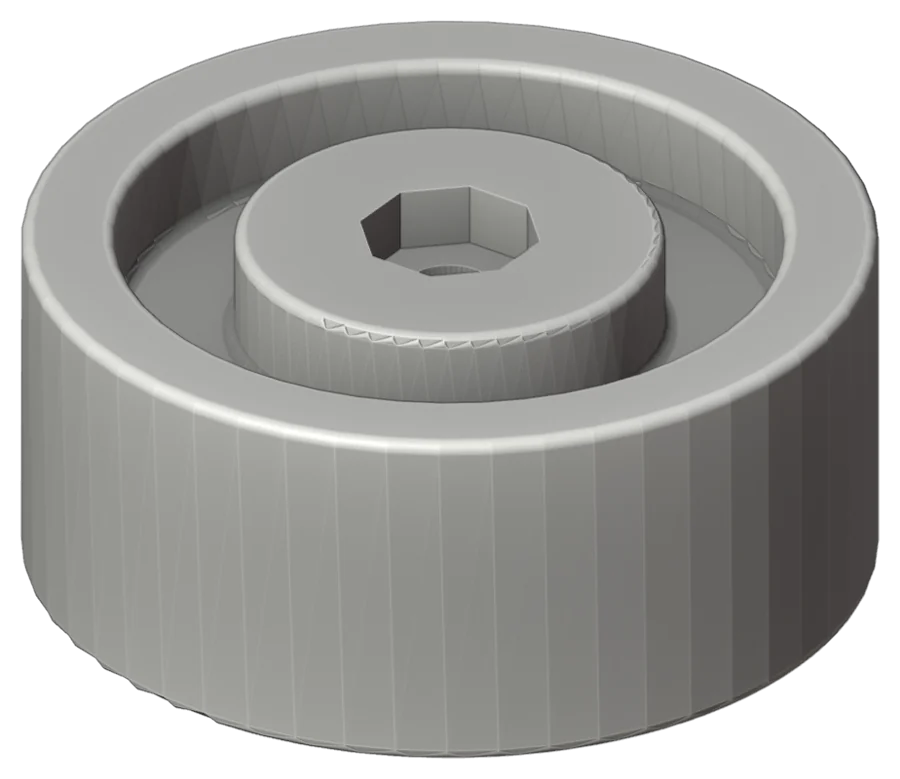
A complex single casting is expensive to tool and hard to fill with a fibre composite. In January 2025 Zachary Huser redesigned the brick as two moulded halves that assemble into one unit, with a two-degree draft so the halves release; Brady Kirk printed them at full size. Later that year the founder, having taught himself SolidWorks, took the idea further: a brick of fourteen small parts, each moulded simply and put together quickly, a bit like a puzzle box, with six of the inserts acting as clamps that hold the halves together. A provisional patent on the approach was filed on 9 December 2025. A one-centimetre toy version followed, so that whole structures could be built in the hand.


2026 turned one brick into a system
Between January and June 2026 about a thousand model bricks in some fifty types were printed, and friends and advisors spent an afternoon building with them (see the party). What makes SeaBrick unique is the smooth side locking, which together with the hexagonal geometry gives connected bricks a structural fluidity. The final brick is a hexagon about one and a half times as wide as it is tall, with a lock on each of its six sides. It is laid flat in mats, stacked in rings for tubes and towers, and tied course to course with double-height bridges. In September 2026 the production design, made for a compression press, was completed. The shape is settled.